Under-Sink Organizers: How to Save Space in Small Kitchens
The cabinet under the sink is often one of the most underutilized spaces in the kitchen. Pipes, the drain trap, and cleaning supplies make it difficult to keep it tidy, especially when the kitchen is small.
With the right organizer, you can make better use of the cabinet’s height, separate items, and access them without having to take everything out every time.
Disclosure: Some links in this guide may be affiliate links. As an Amazon Affiliate, I earn from qualifying purchases that meet the applicable requirements.
What Kind of Under-Sink Organizer to Choose
Not all cabinets are the same. Before buying, you should focus primarily on the available space and the location of the plumbing.
| Type of Organizer | Best for | Main Advantage | Things to Consider |
|---|---|---|---|
| 2-tier pull-out | Deep cabinets | Easy access to products | Check height and plumbing |
| Adjustable shelf | Sinks with a central trap | Fits around pipes | Measure the interior width carefully |
| Stackable drawers or baskets | Small cabinets | Make the most of vertical space | Require a stable base |
1. Two-tier pull-out organizer
This under-sink organizer stands out because it combines two sliding levels with a structure that’s adjustable in width and height—especially useful when there are pipes or limited space. It’s a great solution for keeping cleaning supplies organized and making the most of a tricky cabinet.
It can be used to store cleaning supplies, sponges, bags, cloths, and other small accessories that usually end up jumbled together inside the cabinet.
You might be interested in this if you have a deep cabinet, want easy access to items stored at the back, or need to organize items on two different levels.
Before buying: measure the width, depth, and interior height of the cabinet. Also make sure that any pipes don’t prevent the drawer from moving.
Affiliate link
2. Adjustable Shelf Around Pipes
One of the most interesting solutions for making the most of the space under the sink is a shelf designed to leave gaps around the trap and pipes.
This way, you can create a second level inside the cabinet without blocking the plumbing.
It’s especially useful in small kitchens where every centimeter of storage counts.
You might be interested in this if you have a lot of pipes taking up the center of the cabinet, need to use the full width, or prefer a simple structure without drawers.
Before buying: check how adjustable the shelf is and measure the exact position of the pipes.
Affiliate link
3. Stackable drawers or baskets
Stackable baskets and drawers let you create multiple levels of storage without modifying the cabinet.
They’re a simple solution for organizing small items and preventing them from piling up behind one another.
They also have the advantage of being reusable in other closets if you move.
You might be interested in these if you rent, want a solution that’s easy to move, or have a small closet where a large organizer won’t fit.
Before buying: make sure the baskets can be opened easily once they’re inside the cabinet.
Affiliate link
Before buying: measure the cabinet
This is where we avoid many wrong purchases.
Always measure the interior width, depth, and height of the closet, and note the locations of the drain trap, shut-off valves, and pipes.
It’s also a good idea to check how much space the trash can takes up if you have it installed inside the same cabinet.
An organizer may look small in a photo but turn out to be too big for the available space.
Watch out for moisture
The space under the sink can be prone to minor leaks, condensation, or splashes.
That’s why you should avoid materials that deteriorate easily when exposed to moisture and keep a certain distance between stored items and water connections.
It’s also a good idea to check the bottom of the cabinet from time to time for any leaks.
Which solution to choose for a small kitchen
If the cabinet is deep, a pull-out organizer is usually particularly convenient.
When pipes take up a large part of the space, an adjustable shelf allows you to make better use of the available space.
And if you’re looking for something affordable, simple, and easy to move, stackable baskets offer a lot of flexibility.
You don’t need to fill the entire cabinet with accessories. In small spaces, it usually works best to use just a few well-chosen organizers.
Make use of the kitchen walls, too
If you still need more space after organizing your cabinets, you can make use of walls and tiles without drilling holes.
We have another guide with different solutions:
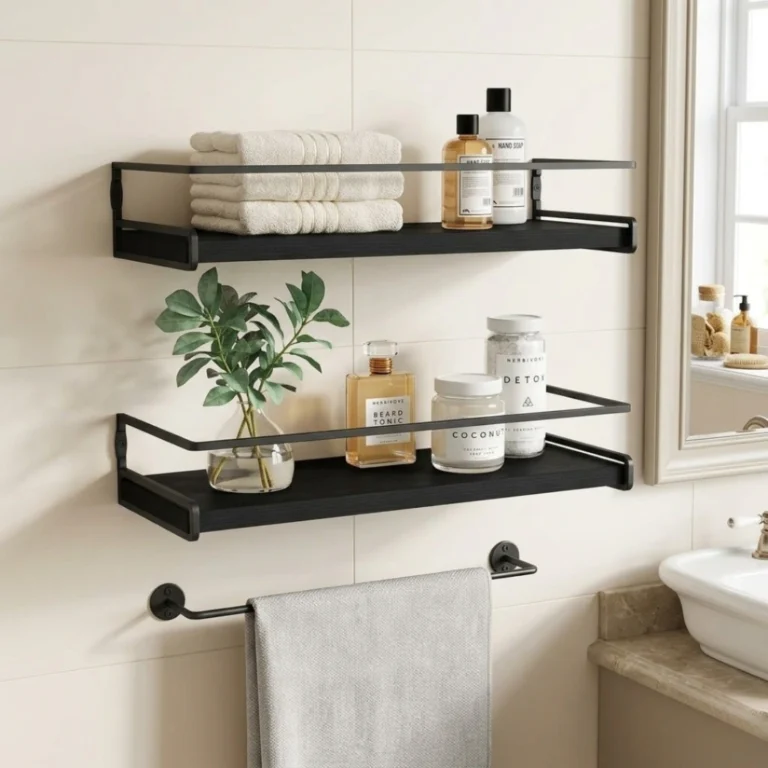
Drill-Free Shelves for the Bathroom and Kitchen
This is also how we begin to link the two guides together.
In summary
Organizing the space under the sink effectively can free up quite a bit of room in a small kitchen without replacing cabinets or doing any renovations.
The key is to measure first, take the plumbing into account, and choose a system that truly fits the available space.
For rental apartments, we prioritize solutions that can be easily installed, removed, and reused.